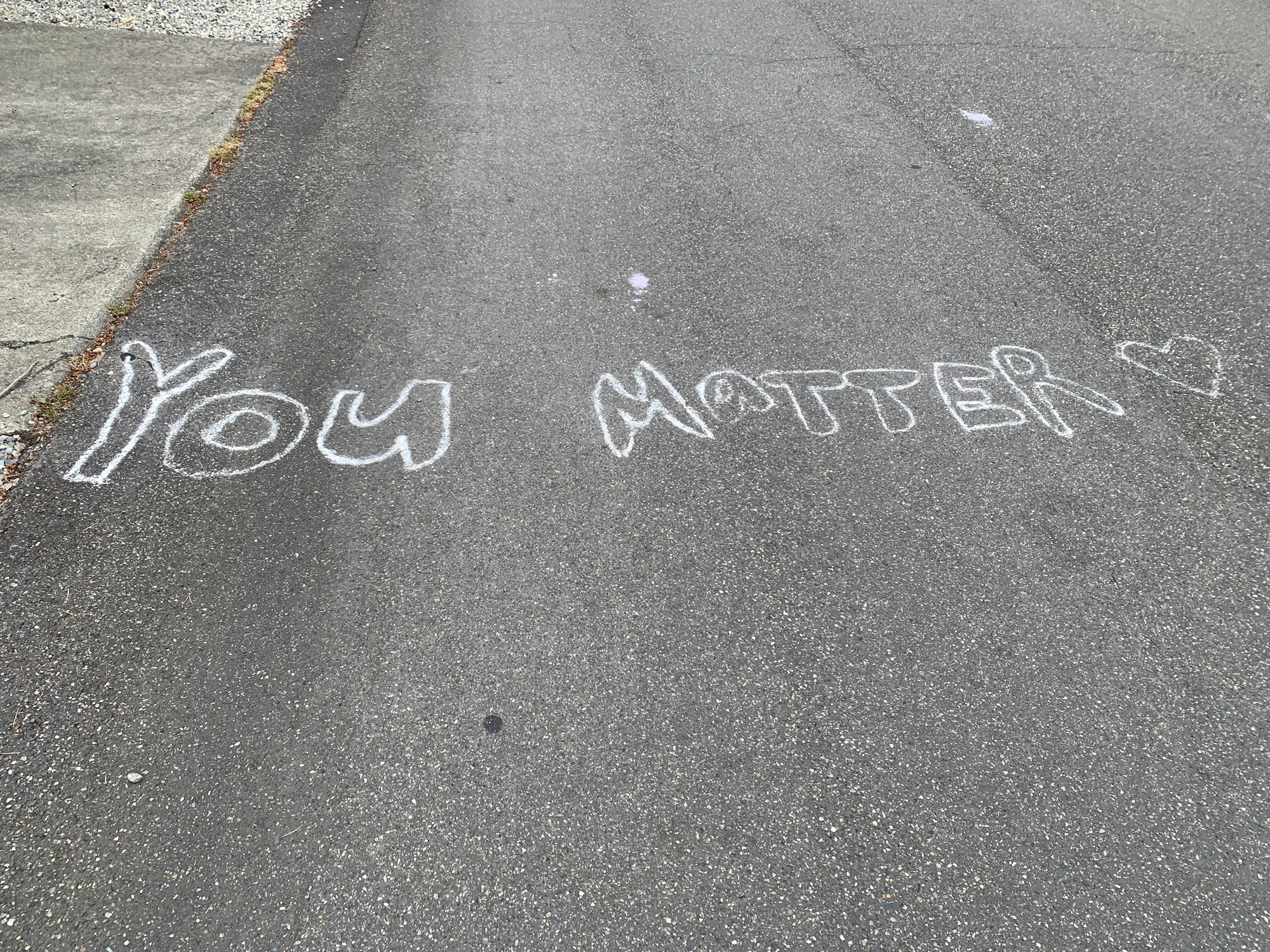
Last week I was on my daily walk in the neighborhood, always an interesting balance between getting needed ‘steps in’ for exercise and also being attentive to the life around me. As I went over a hill I noticed written in large chalk letters, ‘You Matter‘. It is summer school holidays where I am at the moment, and most likely a kid wrote the message earlier that morning or the evening before. But why? I haven’t discovered the answer to that question, and probably never will, but what a powerful message it is.
You Matter. As I continued on my walk that day, and in the days since, I have reflected on the truth behind those words. I do matter, so do you. But to whom do we matter? To our families of course, to our friends. And for those of you reading who are like me and believe in a God that loves us, we matter first of all to our Creator. The majestic revelation that we personally matter to the God of the multiple universes who created it all is so hard to fathom. But I believe it is true.
You Matter also in the broad sweep of human history. That is what I would like to more specifically focus on in this post. As I reflected on my walk that day and since, I have considered again how important my voice, and your voice, is to your world and way beyond. To believe our voice and choices are important in history can lead us to a sense of aggrandizement and narcissism, but it can also bring a deep humility and sense of responsibility. What we say matters way beyond our limited frames of reference. What we do, or what we don’t do, can have an effect that is literally history-altering.
As a kid I first saw the Christmas classic ‘It’s a Wonderful Life’ starring Jimmy Stewart as the primary character, George Bailey. First released in 1946, it was loosely based on Philip Van Doren Stern’s short story , ‘The Greatest Gift‘. That story had been inspired by the Charles Dickens’ classic ‘A Christmas Carol’. Watching ‘It’s a Wonderful Life‘ has become a Christmas tradition for many families, including ours when our daughters were young. (Though we never got very far before we all felt too sleepy and turned it off. It’s a long movie!)
Perhaps the central theme of this movie, is that You Matter. George Bailey, a bank executive that runs into terribly hard times, becomes convinced that it would have been better for everyone, including his own family and close friends, if he had never existed. He is about to act on that despair and take his life, when an Angel named Clarence Odbody shows up in the nick of time, (as angels often do), and proceeds to show George a sequence of scenes as if he had never existed. George sees that without his seemingly insignificant little life, his own family, friends and neighbors, and city would be deeply impoverished and morally corrupt and in some cases would also never exist.
Seeing how history and the future would have gone if he had never existed shows George Bailey that his life truly mattered. His response was to find a hope that led to needed changes and solutions to the problems he and those around him faced. Why is this movie a classic for many, and why do so many want to watch it at Christmas season each year? Yes it is a heart-warming tale, a bit corny at times but played with a sweetness and charm by famous actor Jimmy Stewart. But is it also the powerful message of You Matter that draws people? A message of hope in a world with plenty of dark shadows?
Our small and seemingly insignificant choices and lives do matter. They do affect history. Recently I’ve been reading a biography of the last German Emperor (Kaiser), Wilhelm II, titled The Last Kaiser by Giles MacDonogh. I had been interested in him for some time, as he is sometimes called the primary villain in the starting of World War I from 1914-1918, at least as told by the ‘victors’. As often happens, the reality is rather more complicated. The Kaiser was a very conflicted man, and his involvement in the lead up to the war is also a complicated story. In some ways World War I in its European dimensions was a deadly family feud. Wilhelm’s grandmother was Queen Victoria of England though his mother Vicky, and another relative in the extended family was Czar Nicholas of Russia.
Wars are started by people, and often leaders who are driven by passions, slights and arrogance. In the case of WWI, it was a classic case of leaders who were related coming to blows with their Empires behind them, and Wilhelm was certainly not the only ‘villain’ of the story. Personal choices matter, for good or for evil. And millions can be affected as a result. In WWI, the start of the escalating series of events resulting in a global conflict started with the assassination of Austrian Archduke Franz Ferdinand and his wife in Sarajevo on June 28, 1914. One leader’s death and the ripples that were created overwhelmed several empires and millions of people.
Another example from here in the United States happened only three days ago. We had not had an assassination attempt on a President or candidate for President since 1981 when Ronald Reagan survived an attack. On Saturday, a 20 year old gunman came very close to assassinating the former President and present candidate, Donald Trump. It was a shocking and sad day to see this kind of political violence again in this country. Thankfully, Trump survived with minor injuries, but one man was killed and two others injured.
Very little is still known about the 20 year old as to his motives, as I write this post. Very likely more will be discovered soon. Sadly for his family but fortunately for others, the gunman was killed before he could get off more shots. But think of the implications of one young man’s actions on the events of history, as has happened too many times before in acts of violence in our world and our history. But think also of the innumerable acts of human goodness that have also happened and changed history for the better.
You matter. Today. Your one life is important, and there will be never be another on planet Earth like you. Choose wisely.
 Encounters of Faith in Asia: Past, Present and Future