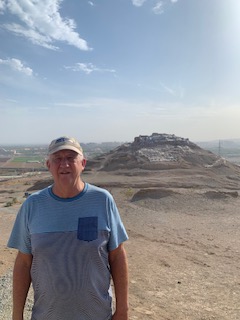
Last September I had the privilege to travel across China and into Central Asia with a small team, along one of the routes of the ancient Silk Road. For the first part of my writing, see Pilgrimage across the Silk Road: Part 1. In this second section, I will continue to bring out some of the highlights of a very rich and diverse time. Though only officially named ‘The Silk Roads’ in the 19th century by the German geographer Ferdinand von Richthofen, these routes go back over two thousand years along both land and sea. They were key linkages for world trade and traveled by many nationalities. One of the groups I mentioned in my last post, and have written about in a prior post, was the Sogdians. (See The Bugis and the Sogdians: Two Merchant Peoples in Asia with a Mission). Though no longer an existing race but very much present in their descendants the Uzbeks, the Sogdians were found all along the Silk Road including in far Eastern China. Along our whole trip, we could not get away from the Sogdians being mentioned. In fact, when we got to Samarkand in modern day Uzbekistan that was the capital of Sogdiana, we had a wonderful encounter with a ‘living Sogdian’. Two of the ladies on our team had started talking to a young lady and asked her name. She replied ‘Diana’, sharing that it was short for ‘Sogdiana’! Evidently people in the area still named their daughters after the ancient name, recognizing its importance and treasured heritage.
Another highlight of this trip was being able to visit sites along the way that were once thriving centers of the Church of the East but now ruins or simply stones. In the photo above, I’m standing in front of an amazing mound that was once a Church of the East monastery and very large church complex. It is near the city of Turfan (Turpin) in the far west of China. The site had seen some excavations in the past, but seemed deserted for quite some time. But it was clearly titled a monastery of the Church of the East on the outside placard. We had quite an adventure finding it one afternoon as it was off the beaten tourist tracks. And without a very adventurous local taxi driver I’m not sure we would have gotten to it! But what a treasure to see it, and to imagine what it would have been at one point. This was a hugely important mission sending and transit site along the Silk Road for Church of the East missionaries in the 7th-9th centuries going farther east into China or routes south into what is now South Asia.
At one time there may have been up to three hundred monks in residence here, and perhaps more coming and going. This was only one of the main centers along the Silk Road for the Church of the East. Many of them are only ruins now or not even having any visible remains. With every one of them, a graveyard was most likely there. But in almost every site, the cemetery is no longer visible. Up until recently, one of the only cemeteries of the Church where gravestones were extant was near Lake Issu-kyl in modern day Kyrgyzstan. But in the past few years a cemetery has been excavated in what is now Uzbekistan. More on that in a future post on the treasures of the Silk Road.
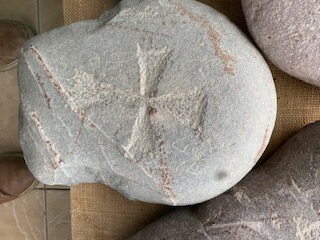
Another existing cemetery we were able to see on this trip was near Bukhara in Uzbekistan. Though most of the graves were Muslim, in a nearby small museum were several Church of the East gravestones that had been most likely removed from graves at some point over the centuries. We could see this from the distinct cross type on the stones. I barely snapped the photo below left before a Russian tour group was told very strongly by a guard that they were not to take photos! Of course I complied, but as slowly as I could and not before getting in a few more pics!
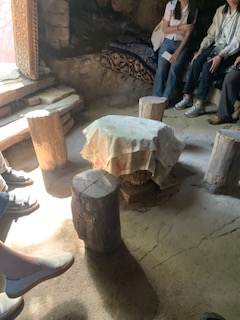
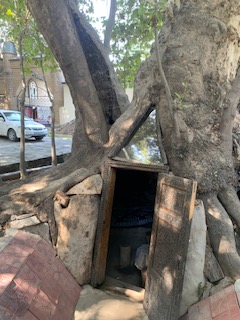
The last place I will write about in this post is Samarkand, a beautiful and historic city along the Silk Road, and at one time a center for the Church of the East. Our team spent several days there, staying with local Christian leaders. One of these leaders knew quite a bit about the history of the ancient Church, and took us to several sites. One place he took us to was outside the city, and this location featured a tree. (photo above). But this was not just any tree! It was a place going back to perhaps the 4th or 5th century that had a church meeting place inside! Though now advertised with its more modern Muslim history, it is clearly still known as originally a place where Christians worshipped. We were able to gather inside with our local hosts (photo above), and the local Christian pastor led us all in communion. It was one of the most moving times in the whole trip for me, connecting the
This pilgrimage along the Silk Road was not only about visiting historic sites or long deserted ruins. It was also about seeing a living Church and a new generation interested in that history like never before. This was true in China and also in Central Asia as well. In the next post, number 3 in this series, I will write more about that new generation and the hope in the future connected to the history. I’ll also write more about the Maritime Silk Road and some amazing discoveries in recent years confirming its widespread importance in trade and culture. What continues to be so very exciting is the amount of new excavations and discoveries along both the land and sea routes. These findings and treasures are confirming some theories held for decades and centuries by explorers and others interested in connections and interactions across Asia. It is indeed an exciting time to be alive!
 Encounters of Faith in Asia: Past, Present and Future
Wonderful! Thankyou! This is indeed very exciting. I have always been fascinated by that part of the world. So glad you can make this trip and write a blog about it
On Sun, 8 Mar 2026, 11:25 pm Encounters of Faith in Asia: Past, Present and
LikeLike