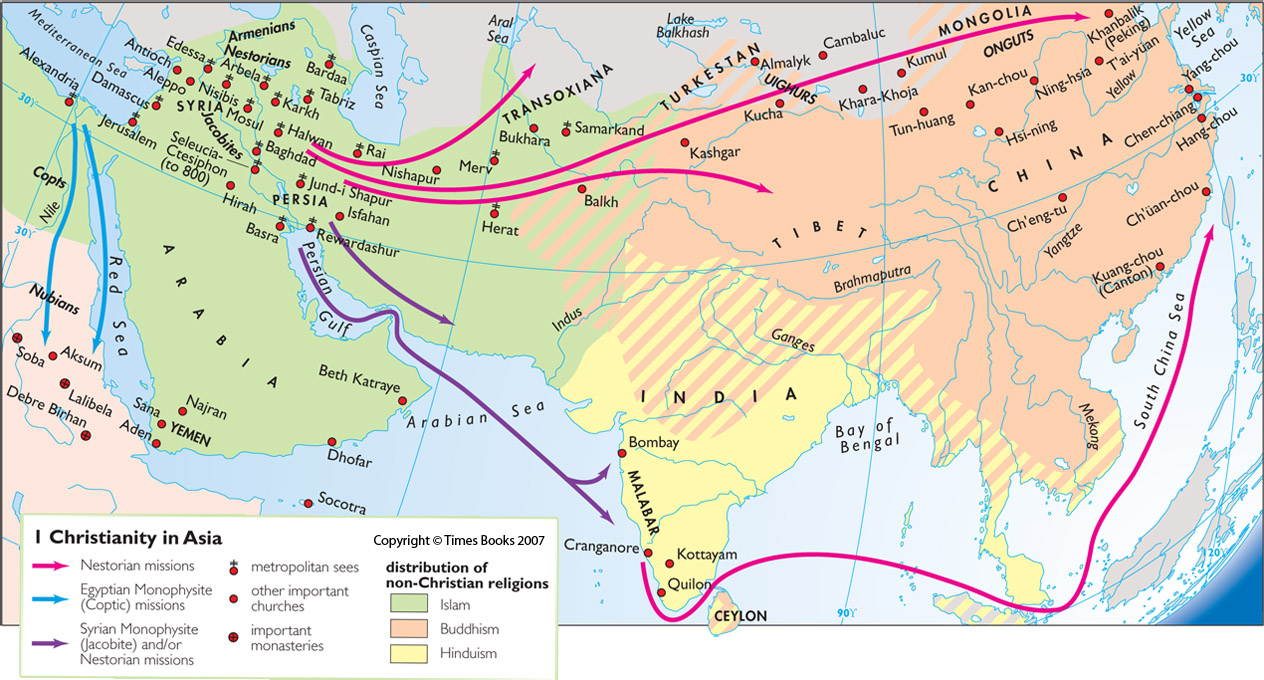
How would Christian history be different if the Apostle Paul had traveled on the trade routes (the ‘Silk Roads’) to the East into the Persian Empire rather than stayed within the Roman Empire and ended his life in Rome? What if Paul, with all his gifts and abilities, had been not only the ‘Apostle to the Gentiles’ but the ‘Apostle to the East’? What if he had made Edessa, the key city in the spread of the Christian faith to the East in the early centuries, instead of Antioch and Rome, his base? Joining or following most likely the Apostles Thomas, Thaddeus and Bartholomew who moved East from Edessa?
These are of course speculative questions, following in the genre of ‘alternate history’. I have loved thinking about and reading articles and books of this nature, where actual events in history are imagined as if they had happened very differently. And what would be the implications to the future from that event or people involved changing?
For those of you interested in alternate history, there is much you can read in this area. But perhaps you could start with the ‘What if?‘ series of books edited by Robert Cowley. These books are a collection of chapters with each one written by a historian examining a historical event or period, and then imagining how different it could have gone. For example, what if John F. Kennedy had not been assassinated on Nov. 22, 1963? Would the USA still have gotten into the Vietnam War? Or what if Adolf Hitler had died in World War I as a soldier, how different would history have gone?
Before we consider these questions about the Apostle Paul, let’s consider what really did happen and the context. The Roman and Persian Empires shared a common border along what is now parts of Syria, Iraq, and Turkey. For over 700 years, they jockeyed for position, fighting numerous wars in their various different rulers and configurations. For many that studied Global History from educational backgrounds in the West, the Roman Empire figures very large in our minds. We perhaps hardly heard of the Parthians, Sassanians and final versions of the Persian Empire as they fell to Islam in the seventh century.
This is much the same for those studying Christian history, as Western historians primarily only focused on Christianity spreading in the early centuries in the Roman Empire around the Mediterranean Sea and not to the East except perhaps a stray reference to Thomas going to India. As I titled my second book, it was truly ‘Asia’s Forgotten Christian History‘. (Cochrane 2018) For a recent and quite comprehensive book on this 700 year history of Rome and Persia, I recommend Adrian Goldsworthy’s ‘Rome and Persia.’
Along with Apostles Thomas, Thaddeus and Bartholomew, part of the original twelve disciples of Jesus, there were others that journeyed East by the end of the first century via Edessa and on to Mesopotamia and Persia. (what is now Iraq and Iran). These Christian missionaries traveled along the existing trade routes, known as the ‘Silk Roads’:branches of which were on the land and went all the way to China and Central and South Asia, and some that were by sea, the ‘Maritime Silk Roads’, circling around India into SE Asia and on to China. Wrongly titled ‘Nestorians’, (as Nestorius didn’t appear for three more centuries), this was the Church of the East that spread all the way to China by the seventh century. (For those interested in reading more of my blog posts on the Church of the East mission spread to the East, see Where Have All the Christians Gone?, Where did the Wise Men come from? And go back to?, and there are many more….)
So if St. Paul had turned East rather than West, he would not have been alone. There were established roads, as the Romans not only built good roads, so did the Persians. There were trade routes to the East and Paul could have gone all the way to China on them. In some cases these routes were even more established than the ones to the West. Paul had been commissioned as the ‘Apostle to the Gentiles’ in Acts 9:15, but it was not specified what kind of Gentiles and that could have been Persian Gentiles, Indian Gentiles, Chinese Gentiles, etc. He also could have reached out to Jewish communities in the East as many were still in Mesopotamia from the years of exile, and even according to tradition they were as far East as India where Thomas perhaps started his ministry among them. Paul would not have had language problems, as Greek, Hebrew and Aramaic were known in many parts of Asia due to the conquests of Alexander the Great, trade connections, and the diaspora of the Jews.
In answer to the speculations of this blog post, some may quote the verse in Acts 16:6, where Paul and Silas while traveling in parts of what is now Turkey, were ‘forbidden by the Holy Spirit to speak the word in Asia.’ So instead of turning further East to preach the message of the Gospel, which could have taken them into what is now Iraq and at that time part of the Persian Empire, they went to the West to Troas and then followed a ‘Macedonian call’ to Greece. But this did not necessarily need to be a final word that they would never preach the word in Asia, but only for that season of their ministry travel.
With the amount of travel Paul did, it could also have been possible that he returned to Eastern Turkey and on into Mesopotamia, if he had not met his end by execution in Rome. Of course he may have also gone further West to Spain, as he longed to preach there until the end of his life. (And it seems most likely that he indeed never made it there). According to Richard Bauckham, author of an intriguing article titled ‘What if Paul had gone East rather than West?‘ (Biblical Interpretation, Vol. 8, April 2000), Paul in the East ‘would have targeted Hellenistic cities with significant Jewish communities‘. (pg. 177). And Bauckham speculates that Paul could have gone to Edessa, traveling then into Mesopotamia to cities like Nisibis which later became a major centre for Christian education. Later journeys of Paul could have included Baghdad itself, Susa at the heart of the Persian Empire, and even across to India either by land or sea.
All of this of course is in the realm of alternate history. This is not what actually happened. Paul’s letters to churches in Western Asia (now Turkey) Greece, and Rome were circulated and became part of the New Testament. He did not go to the East, certainly not beyond what we now know as Turkey. It was not only because of Paul’s life, ministry and letters, but certainly he was a major influence towards Christianity being identified as a ‘Western religion’ as it grew around the Mediterranean Sea. But at those same early centuries, the Christian faith was growing also to the East in the Persian Empire and India. What if the Apostle to the Gentiles was also the Apostle to the East? How would that have changed the perception, impact and strengthening of the churches in the East? Would it have made any difference if Paul had spent even the last decades of his life in the East if he had not been executed in Rome?
Alternate history may seem to some readers as a quirky or nerdy waste of time. But it can also yield insights as we consider other perspectives of what might have been. It can cause us to re-look again at actual events, knowing that when people were living through them things could have gone very different ways. Perhaps we can learn though the choices people actually made, or what could have happened if they chose differently. As we re-imagine how events may have gone, we learn to appreciate even more deeply how life itself is so fragile, how easily things can turn out differently. And we also learn how important individual choices are in the scope of grand historical events. Our choices each day….
 Encounters of Faith in Asia: Past, Present and Future
What if Mohammed had been converted? Might he have become an apostle to the Middle East and central Asia?
LikeLiked by 1 person
Hi Al,
Thanks for writing. That is really fascinating question and would make a great article or post? I’ve seen some SF material on what if Arab armies had won the battle of Tours in Southern France in about 723 and kept going into Western Europe, and if it was Muslim today including England. But never seen anything written on your question, what if Mohammed had converted and become an apostle to the Middle East and Central Asia. So interesting to think about, thanks.
LikeLike