The past six weeks has been a wonderful journey of learning adventures in Japan. I was helping lead a School of Redemptive History which we have had in several nations over the past eight years. Going into Japan we did the same as before: focusing on the particular history of the host nation while also including the bigger regional and global perspective.
In Japan this included looking at their history of the Christian faith. In the late 16th century the Jesuit missionaries from primarily Portugal and Spain began work in Japan, and within the next few decades the faith spread to over 300,000 adherents. But from 1597, and then again even more strongly after the next two decades, a savage persecution began from the ruling Shoguns. Many martyrdoms resulted and Christianity was banned overall in 1614. Over the next almost 250 years, small communities of Christians held on to faith in remote areas like the Goto islands as well as Nagasaki and Oita, while not having any surviving priests or access to scripture beyond portions. They are called the ‘Kakure Kirishitan’, or ‘Hidden Christians’. (Perhaps the best overall book on the subject is In search of Japan’s Hidden Christians: A Story of Suppression, Secrecy, and Survival by John Dougill. (2012).) And see my post Silence Part 2: The ‘Hidden’ Japanese Christians that I wrote when the move ‘Silence’ first came out.
As part of our learning journey, the class visited some of the sites associated with this history especially in Nagasaki area and Oita, centers for the Christian faith in the period of persecution but also into the modern period. The second atomic bomb was dropped by the USA on August 9, 1945 at 11:02 am over a strongly Christian part of Nagasaki, with 8,500 out of 12,000 Christians in the area being killed that day among the thousands of others. The most sobering, and frankly overwhelming emotional day for me of our week long field trip to Nagasaki and Oita, was when we visited in the morning the martyrs museum in Nagasaki dedicated to the persecution of Christians from 1597 and onwards, and in the afternoon the atomic bomb museum and ground zero memorial. This was too much for one day if you ever get to Nagasaki! But due to our overall schedule school wise it was necessary.
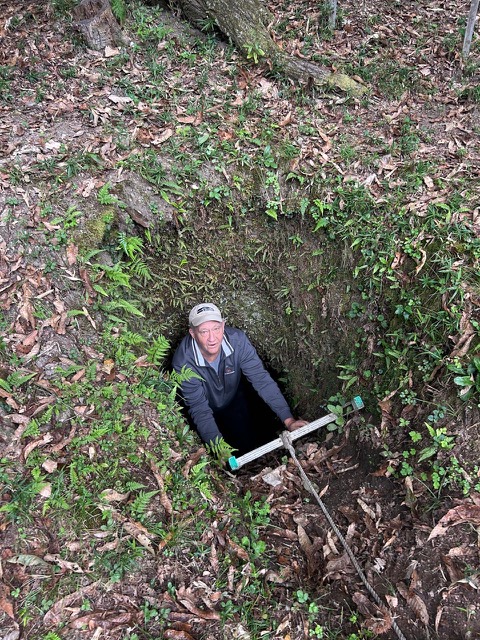
After the days in Nagasaki, we went to another center for the Japanese church, Oita, on the other side of the island of Kyushu. There we were treated to three days of visiting historic sites of the persecuted Christians by our YWAM colleague Tim who has lived there with his wife for several years. (if you ever get to Oita, I highly recommend you have Tim be your tour guide.) One of the places Tim took us to is one of the most powerful sites I have ever visited. It was one of many, perhaps hundreds at one time, underground small caves accessed by a ladder and open to the public. (many of these caves were perhaps filled in as the authorities discovered them over the centuries). You can see me in the photo emerging from the cave.
It is hard to describe the emotions when I was in the cave and thinking about what it would have been like to be worshipping and taking the Eucharist. (an altar is still there). Only about five at a time of our group went down, and most likely the maximum number able to be in that cave at one time would have been ten in a very cramped condition. These caves were probably used at night, with perhaps someone standing guard above. They were often located, like this one, just outside the cities in the surrounding hills and mountains. These Christians were hunted constantly over the two plus centuries, hiddenness being their reality. Yet so many did not give up the faith, though at times without priests and scripture it took new contextual forms.
And in many ways these hidden Christians worshipping in underground caves are a metaphor (and reality) of a vulnerable faith with a symbol (and reality) of a cross at its center. Being in this cave reminded me of a pilgrimage last year along the Silk Roads. In Uzbekistan just outside the city of Samarkand, our small group visited a tree whose roots included an underground cave where Christians gathered to worship in the seventh century onwards. We had two Uzbek pastors with us and we asked them to lead us in communion there in the cave. It was a stunning moment considering so many centuries ago the followers of Christ worshipping there, and the connection now with the living faith of the Uzbek church. To read more about that experience, see Pilgrimage along the Silk Road: Part 2.
As missionary statesman and scholar Andrew Wallis reminds us: ‘Christian advance is not steady inevitable progress. Advance is often followed by recession. The spread of the gospel does not produce permanent gains that can be plotted on a map.’ There are not ‘gains’ that we can say, ‘we have done that’ in our human pride. Rather, Professor Walls reminds us that: ‘Christianity has vulnerability at its very heart, fragility in its expression. It’s perhaps the vulnerability of the Cross and the fragility of the earthen vessel.’ (Walls 2002: 3).
This vulnerability of the Cross and fragility of the earthen vessel has certainly been true in Asia since the first century spread to the east, as well as in the early seventeenth century in Japan. Contrasting the Christian faith with Islam and the way it ‘held’ the territory it gained, Walls writes this: ‘Christian progress is serial, rooted first in one place, then in another. Christianity has no equivalent of Mecca, no single permanent center. Christian communities often wither in their heartlands, their areas of seeming strength, and then flower anew at or beyond the periphery. No one country, no one culture, owns the Christian faith. There’s no permanent Christian country, no one form of Christian civilization, no single Christian culture. At different periods, different areas of the world have taken leadership in the Christian mission and then the baton has passed on to others.’ (: 3). That has certainly been true of Asia and is happening again in this century.
I am so grateful for these past few weeks in the wonderful nation of Japan. Another highlight of the time was how openly the nation remembers and even celebrates the history of the martyrs of the Christian faith. I have lived and worked for decades in nations like India and the Muslim world that have very little remembrance in a public way of the martyrs of the past. Yet Japan does not hide the savage persecutions of the 17th century, instead remembers it with various memorials and remembrances. That in itself invites more reflection on what the future may hold for the Christian faith in Japan.

